THE YOUTH SOCCER DEVELOPMENT INTELLIGENCE SYSTEM

A smarter cycle. Stronger athletes. Better outcomes.

SportsRubrIQ is a player-development intelligence system built to answer the question youth soccer has struggled to answer: “Is this player actually improving?” Instead of relying on opinions, team results, or isolated observations, SportsRubrIQ creates a common developmental language, a standardized assessment process, and a longitudinal record that follows the player from ages 5 to 18.

It connects curriculum, assessment, training, and progress so everyone involved can see not only where a player is, but what they need to develop next. SportsRubrIQ doesn't manage the team — it develops the player.

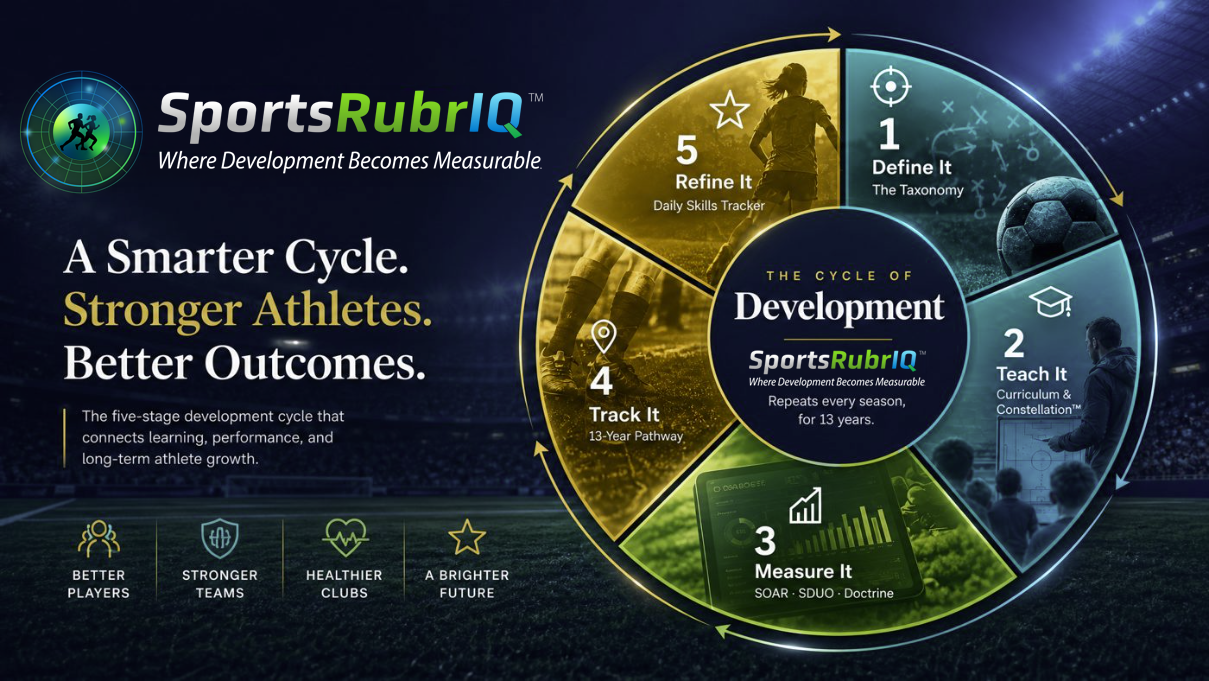
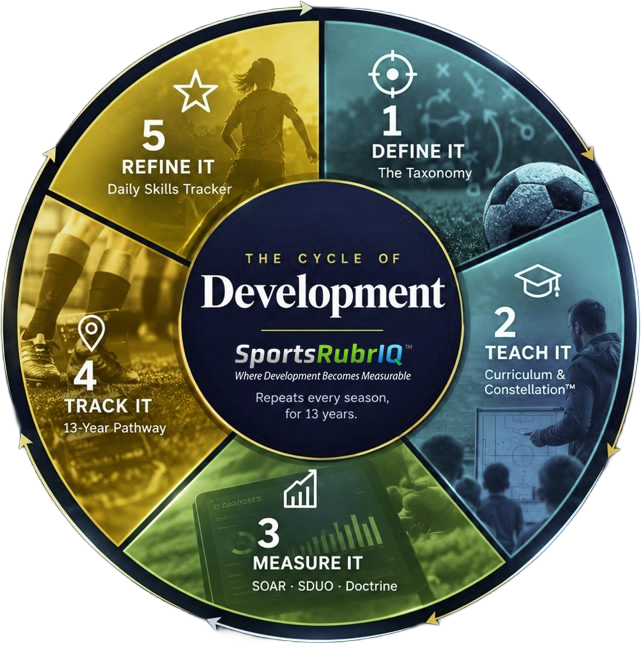
The Cycle of Development
B
BETTER PLAYERS
S
STRONGER TEAMS
H
HEALTHIER CLUBS
★
A BRIGHTER FUTURE

WATCH THE INTRODUCTION

A two-minute look at the framework

A short walkthrough of the SportsRubrIQ Performance System™ — the philosophy, the rubric, and the developmental story it makes visible.

ONE SHARED PICTURE OF DEVELOPMENT

Built for everyone around the player.

For clubs, coaches, players, and parents, SportsRubrIQ creates one shared picture of development — pulled from the same underlying record, so nobody's ever arguing over different numbers.

COACHES

Know what to teach and why — every session traces back to the Taxonomy and the player's current stage.

PLAYERS

Understand exactly what they need to improve — specific skills, not vague feedback.

PARENTS

See what their child is actually developing, in plain language, without needing to interpret a rubric.

DIRECTORS

Gain visibility into whether development is happening consistently across the whole organization.

THE SPORTSRUBRIQ DIFFERENCE

Define it. Teach it. Measure it. Track it. Refine it.

Not another platform for managing teams — a system for understanding and developing players. It turns the traditionally subjective process of player development into a structured, evidence-based journey that coaches can teach, players can own, parents can understand, and clubs can measure.

The Cycle of Development
ASSESS→
IDENTIFY→
TRAIN→
REASSESS→
ADVANCE

STEP 01 — DEFINE IT

Give the game a common language.

Before development can be taught or measured, it has to be defined. SportsRubrIQ's Game Taxonomy breaks the game into a structured framework of skills, behaviors, tactical concepts, phases, principles, and outcomes. The 8-7-6-5-4-3-2-1 framework gives coaches and clubs a shared vocabulary, removing the ambiguity of statements like "good player," "needs work," or "better decision-making" and replacing them with specific, observable elements of the game.

The Taxonomy becomes the foundation for everything that follows. It establishes what players need to learn at each stage, what coaches should teach, what can be assessed, and what development should look like over time.

EXPLORE THE 8–7–6–5–4–3–2–1 FRAMEWORK

Every layer, one framework.

The Outcomes

A goal pathway created when one team temporarily outnumbers the other in a critical area of the pitch, forcing defenders into impossible choices and opening clear lanes to goal.

How It Shows Up in a Match
  • A 2v1 or 3v2 develops on the flank after a fullback is drawn inside, and the free attacker finishes or cuts back for a tap-in.
  • An overload is built on one side to pull the block, then the ball is switched into a newly created numerical advantage on the opposite wing.
  • A midfielder joins the attack late so the final third becomes a temporary +1 against a settled back line.

A goal pathway produced by prolonged control of the ball and territory, wearing down the opponent's shape until gaps appear and a high-quality chance is forced.

How It Shows Up in a Match
  • Repeated circulations around a compact block eventually force a defensive step or a tired clearance that is recycled into a better chance.
  • Sustained pressure in the final third creates second balls, cutbacks, and scrambles that end with a finish from close range.
  • The attacking team pins the opponent deep for long spells, then exploits a late runner when concentration finally breaks.

A goal pathway that starts the instant possession is won and space ahead is open, converting a defensive recovery into a fast, vertical strike before the opponent can reorganize.

How It Shows Up in a Match
  • A midfield interception is immediately played forward into space behind a high line for a breakaway finish.
  • A cleared corner or set piece turns into a long outlet, and the recovering team is outnumbered in transition.
  • A press wins the ball high, and one or two sharp passes create a shot before the defensive shape can reset.

A goal pathway sparked by a singular, exceptional action in the moment—technique, timing, or vision that momentarily breaks the normal logic of the game.

How It Shows Up in a Match
  • A player strikes a curling effort from outside the box that no keeper can reasonably expect to save.
  • A no-look through ball or improvised flick unlocks a locked defensive line in one touch.
  • A bicycle kick, lob, or sudden change of body shape turns a half-chance into an unforgettable finish.

A goal pathway driven by a consistently superior individual whose quality repeatedly tilts match states in their team's favor, beyond a single highlight action.

How It Shows Up in a Match
  • A star attacker repeatedly beats their marker and creates or finishes chances that teammates cannot generate alone.
  • A creative midfielder dictates tempo and finds decisive passes that systematically break the opponent's structure.
  • A dominant goalkeeper or defender repeatedly prevents goals and starts attacks that change the scoreboard trajectory.

A goal pathway caused by technical, tactical, or decision-making errors—giveaways, miscommunications, and poor choices that gift the opponent a clear opportunity.

How It Shows Up in a Match
  • A misplaced back pass or heavy touch under pressure leads directly to a turnover and a goal.
  • Defenders fail to communicate on a runner, leaving someone unmarked at the far post.
  • A rushed clearance or needless foul concedes a dangerous restart that is converted.

A goal pathway originating from a structured restart—corners, free kicks, throw-ins, or penalties—where rehearsed patterns and delivery quality create the chance.

How It Shows Up in a Match
  • A near-post flick or far-post run converts a well-delivered corner into a headed finish.
  • A rehearsed free-kick routine creates a free shooter at the edge of the box or a direct shot on goal.
  • A long throw or short-corner combination pulls the defense out of shape and opens a cutback lane.

A goal pathway that sits outside normal game design—deflections, freak bounces, odd ricochets, or rare events that cannot be reliably coached as a repeatable method.

How It Shows Up in a Match
  • A shot takes a wicked deflection off a defender and wrong-foots the goalkeeper.
  • The ball loops in off a post, crossbar, or unexpected bounce after a scramble.
  • An extremely rare sequence—own-goal chaos, weather-affected bounce, or freak clearance—ends in the net without a clear tactical design.

STEP 02 — TEACH IT

Turn the game into a development pathway.

Once the game is defined, it has to be taught consistently. SportsRubrIQ transforms the Taxonomy into stage-specific curriculum designed around the developmental needs of players from ages 5 to 18. Rather than taking adult soccer concepts and simply making the drills easier for younger players, each stage has its own purpose, priorities, skills, and learning objectives.

The Constellation™ adds another layer by helping players understand the geometry and relationships of the game. Triangles, diamonds, squares, rectangles, and other shapes become visual tools for understanding spacing, support, movement, and combination play. The result is a curriculum that doesn't simply give coaches activities — it gives them a reason for what they're teaching and a developmental destination for the player.

THE GEOMETRIC TRUTH OF TEAM SHAPE

The Constellation™.

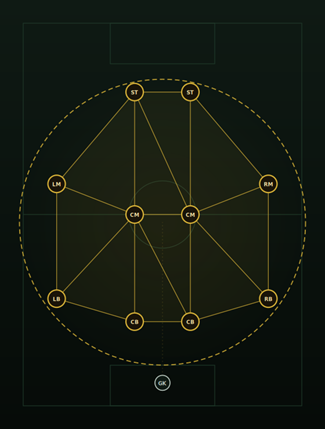
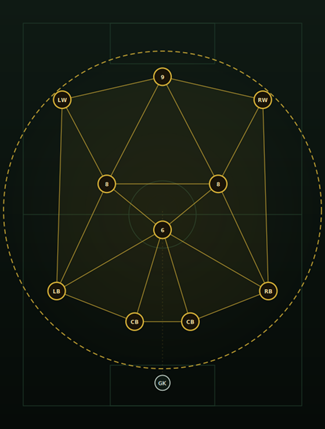
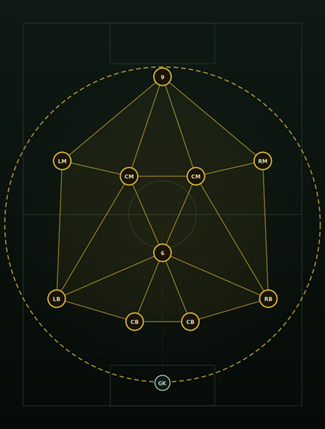
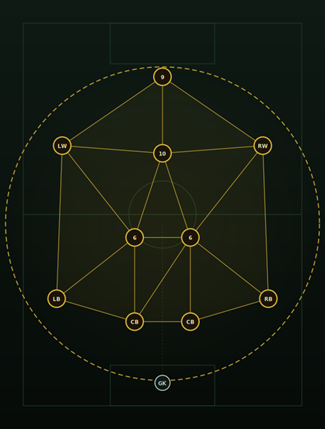
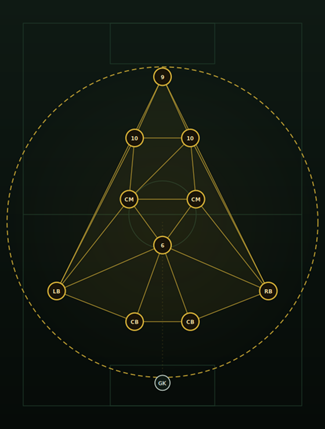
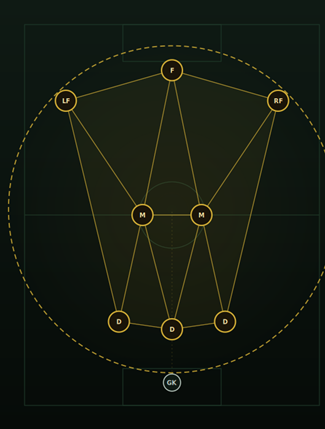
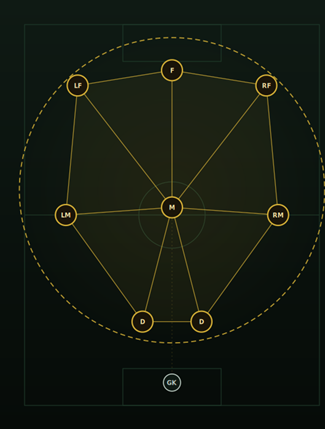
Every team shape in soccer fits inside the same circle. What differentiates them is the “constellation” of triangles, diamonds, squares, and rectangles that make up the passing lanes and the support angles — they are the rondos, the rotational patterns. The formations are just labels. Geometry is the signature.

“Score the pattern, not the moment.”

11v11 · Adult Formations

Ten shapes, one circle.

4-4-2 · Classic Balance
10 TRIANGLES
4-4-2 constellation diagram

Shape Notes

Two banks of four with a strike partnership. Connecting every player to their neighbors creates a web of triangles across the whole shape — interlocking triangles forming passing lanes from back to front.

10
PLAYERS
10
TRIANGLES
19
PASSING EDGES
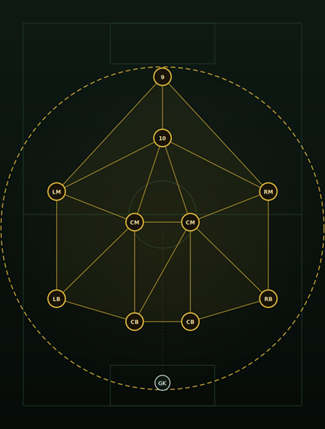
4-4-1-1 · Withdrawn Striker
11 TRIANGLES
4-4-1-1 constellation diagram

Shape Notes

Back four, midfield four, a withdrawn #10 feeding a #9. The vertical stacking of the two strikers creates an extended diamond network through the spine.

10
PLAYERS
11
TRIANGLES
20
PASSING EDGES
4-3-3 · Positional Width
11 TRIANGLES
4-3-3 constellation diagram

Shape Notes

Back four, midfield triangle, front three. Produces the most classical triangle network in the game — every central player naturally triangulates with multiple neighbors, creating the rotational passing patterns associated with positional play.

10
PLAYERS
11
TRIANGLES
20
PASSING EDGES
4-1-4-1 · Anchored Balance
11 TRIANGLES
4-1-4-1 constellation diagram

Shape Notes

Back four, single pivot, midfield four, lone striker. The single #6 becomes the hub of a massive triangle network — connecting to every defender, every midfielder, and the #9.

10
PLAYERS
11
TRIANGLES
20
PASSING EDGES
4-2-3-1 · Staggered Spine
11 TRIANGLES
4-2-3-1 constellation diagram

Shape Notes

Back four, double pivot, attacking three, lone striker. The double-#6 creates parallel spines of triangles — two central conduits rather than one, giving structural redundancy in midfield.

10
PLAYERS
11
TRIANGLES
20
PASSING EDGES
4-3-2-1 · Christmas Tree
13 TRIANGLES
4-3-2-1 constellation diagram

Shape Notes

Back four, midfield three, two #10s, one striker. The narrow stacking produces a dense triangle network — nearly every pair of central players forms an edge.

10
PLAYERS
13
TRIANGLES
22
PASSING EDGES
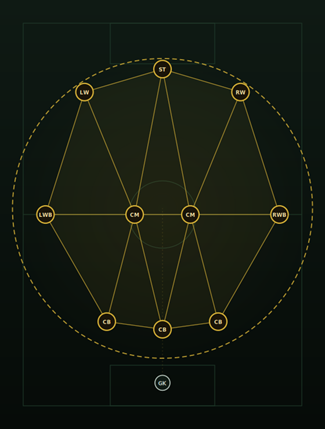
3-4-3 · Overloaded Center
10 TRIANGLES
3-4-3 constellation diagram

Shape Notes

Back three, midfield four, front three. Wingbacks extend the circle dramatically wide, and the three-player defensive line creates a natural chain of defensive triangles across the back.

10
PLAYERS
10
TRIANGLES
19
PASSING EDGES
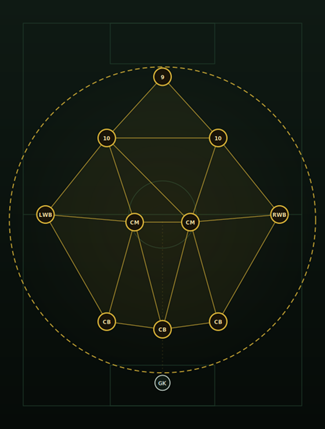
3-4-2-1 · Back Three + 10s
10 TRIANGLES
3-4-2-1 constellation diagram

Shape Notes

Back three, midfield four, two #10s, lone striker. The two #10s occupy the half-spaces, creating overlapping triangles with both wingbacks and the central midfielders.

10
PLAYERS
10
TRIANGLES
19
PASSING EDGES
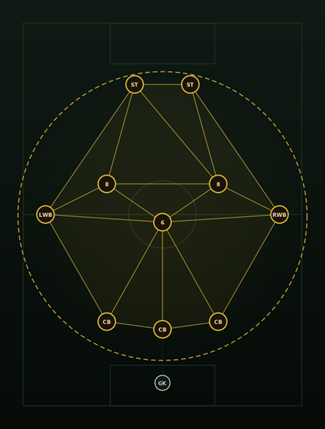
3-5-2 · Wingback Engine
11 TRIANGLES
3-5-2 constellation diagram

Shape Notes

Back three, midfield five, strike pair. Wingbacks, #8s, and a holding #6 create a triangle-dense midfield — seven players across the middle third generate overlapping triangle clusters.

10
PLAYERS
11
TRIANGLES
20
PASSING EDGES
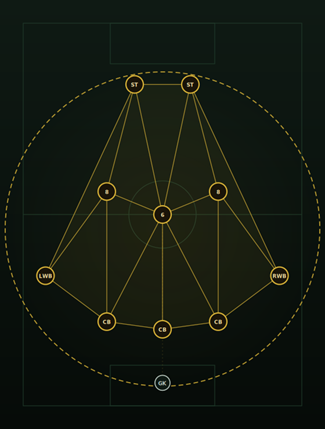
5-3-2 · Compact Counter
11 TRIANGLES
5-3-2 constellation diagram

Shape Notes

Back five, midfield three, strike pair. Mirrors 3-5-2 structurally but with the rim compressed vertically — same network of triangles, spun for defensive posture.

10
PLAYERS
11
TRIANGLES
20
PASSING EDGES

WHERE THE GEOMETRY BEGINS

Youth Constellations.

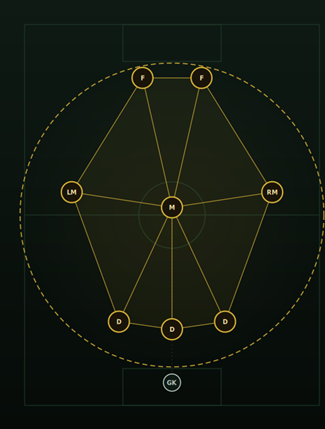
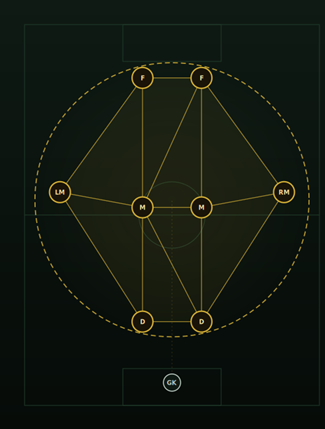
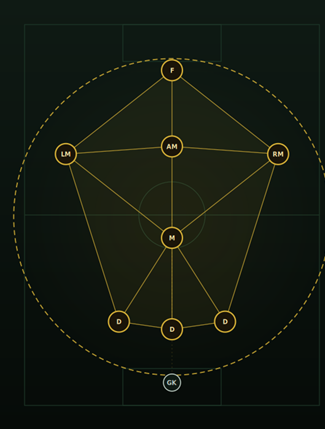
Same circle. Same triangles. Just fewer players. The Fundamental (7-a-side) and Emergent (9-a-side) stages introduce young players to the geometric networks that all adult team shapes are built from — starting with simple webs and growing more complex.

PICK A STAGE

From first triangle to full team.

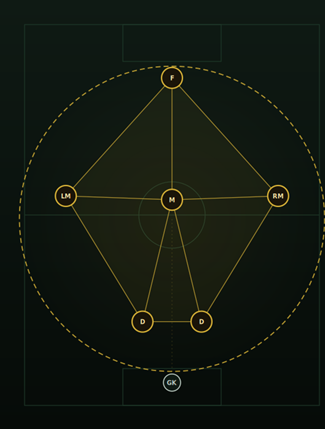
2-3-1 · The Starter
5 TRIANGLES
2-3-1 constellation diagram

Shape Notes

The simplest triangle constellation — 6 players form approximately 4 interlocking triangles. Perfect first shape for young players learning to see connections.

Teaching Focus — Triangles · Support angles · Basic width
6
PLAYERS
5
TRIANGLES
10
PASSING EDGES
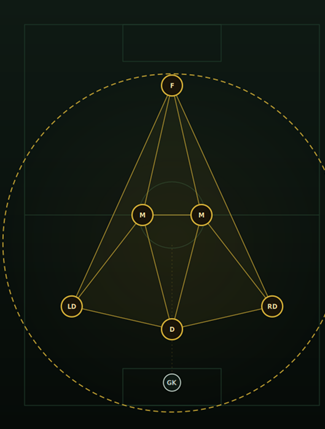
3-2-1 · Defensive Base
6 TRIANGLES
3-2-1 constellation diagram

Shape Notes

Back three creates a wide defensive triangle; two midfielders form the middle connection; striker sits at the tip. Teaches defensive cover through simple triangles.

Teaching Focus — Defensive cover · Central combinations
6
PLAYERS
6
TRIANGLES
11
PASSING EDGES
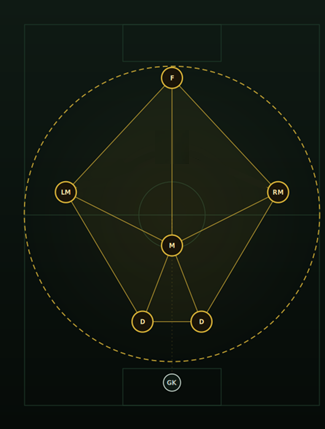
2-1-2-1 · The Diamond
7 TRIANGLES
2-1-2-1 constellation diagram

Shape Notes

The diamond shape creates the richest triangle network possible in 7v7. Every player has 3-4 passing connections. One of the best youth shapes for teaching rotation.

Teaching Focus — Diamond rotation · Third-man runs
7
PLAYERS
7
TRIANGLES
13
PASSING EDGES
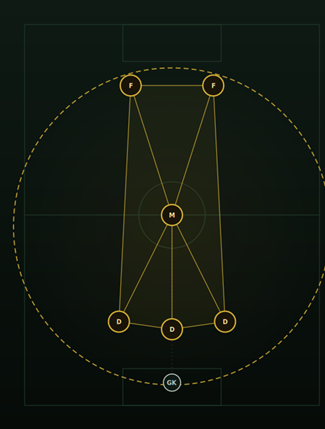
3-1-2 · Two-Striker Shape
5 TRIANGLES
3-1-2 constellation diagram

Shape Notes

A back three creates a wide defensive triangle, with a single midfielder as the hub, and two strikers forming a front pair. Teaches partnerships both at the back and up top.

Teaching Focus — Two-forward partnerships · Pivot play
6
PLAYERS
5
TRIANGLES
10
PASSING EDGES
3-2-3 · Balanced Bridge
8 TRIANGLES
3-2-3 constellation diagram

Shape Notes

The canonical 9v9 shape generates a rich triangle network — a full web of passing lanes. Naturally teaches the rotational patterns that define 4-3-3 at 11v11.

Teaching Focus — Partnerships · Wide-to-narrow rotations
8
PLAYERS
8
TRIANGLES
15
PASSING EDGES
3-3-2 · Midfield Line
7 TRIANGLES
3-3-2 constellation diagram

Shape Notes

Three lines of three (back / midfield / front pair) creates a vertically-stacked triangle web. Great for teaching how to play through lines.

Teaching Focus — Building through midfield · Forward partnerships
8
PLAYERS
7
TRIANGLES
14
PASSING EDGES
2-4-2 · Wide Midfield
8 TRIANGLES
2-4-2 constellation diagram

Shape Notes

A back two with a midfield four and a strike pair. The wide midfielders create triangles that extend the circle dramatically, teaching full-width play.

Teaching Focus — Compact center · Wide mid discipline
8
PLAYERS
8
TRIANGLES
15
PASSING EDGES
3-1-3-1 · Anchored Advanced
8 TRIANGLES
3-1-3-1 constellation diagram

Shape Notes

A taller, more staggered triangle network. The single #6 anchor becomes the hub of the shape, connecting to nearly every outfield player. Prepares young players for 4-2-3-1 at 11v11.

Teaching Focus — Holding midfielder role · Lone striker play
8
PLAYERS
8
TRIANGLES
15
PASSING EDGES
2-3-3 · Attacking Mindset
7 TRIANGLES
2-3-3 constellation diagram

Shape Notes

An attacking 9v9 shape. The front three extends the circle forward, creating a dense network of attacking triangles. Demands brave defending from the back two.

Teaching Focus — Attacking commitment · Brave defending
8
PLAYERS
7
TRIANGLES
14
PASSING EDGES

FROM GEOMETRY TO SESSION PLAN

The Constellation becomes the curriculum.

Once a player can see the shape, the Constellation stops being a diagram and becomes a coaching tool — the same geometry that describes a 4-3-3 on Saturday shows up Tuesday night as the rondo, the passing square, the possession triangle a coach actually runs.

  • Stage-specific session plans with their own purpose and priorities
  • Taxonomy-anchored so every session maps to a measurable skill
  • Gives coaches a reason for what they're teaching, not just an activity

STEP 03 — MEASURE IT

Replace opinion with evidence.

Training happens every day, but development shouldn't be measured by activity alone. SportsRubrIQ measures what the player can actually demonstrate using the SOAR Index™, SDUO™, and the Assessment Doctrine. Instead of asking whether a player is “good” or “bad,” the system looks at consistency, application, mastery, and progression.

SOAR — Seldom, Often, Always, Refined — captures how consistently a player demonstrates a skill, while SDUO — See It, Do It, Use It, Own It — captures the depth of learning and mastery. Together, they let coaches distinguish recognition from execution, execution from application, and application from true ownership.

THE ASSESSMENT DOCTRINE

Four rules the scoring has to follow.

Refined is mastery, not a four.
Score the pattern, not the moment.

Refined is a ceiling marker — the threshold of true mastery, calibrated to Stage 5. Coaches score it sparingly, because the integrity of the record depends on it.

Stage is where the player is — not what their birthday says.
Age tells you when a player was born. SOAR tells you where they are.

Each player has their own current stage, determined by the developmental work they're demonstrably ready for.

Advancement is earned through evidence.
Players advance when the evidence supports it.

A player advances when the coach has effectively taught the material and the player has demonstrably learned and applied it — both, not either.

Educator objectivity replaces soccer subjectivity.
“Is this coach teaching well, and is this player learning?”

Coaches are evaluated as teachers, players as learners — development becomes something you can actually measure.

HOW THE SCORE IS BUILT

Two systems. One developmental story.

The SOAR Index measures frequency of the action. The SDUO Progression Model measures the proficiency. Together they make development legible — domain by domain, step by step, player by player.

LEARNING MODEL — The SDUO™ Progression · Four steps

S

SEE IT

Can the player recognize the action? Vision and pattern recognition before execution — spotting the moment before it happens.

D

DO IT

Can the player perform the action? Isolated, controlled repetition builds the mechanics and confidence to execute on command.

U

USE IT

Can the player perform the action in context? Game-like pressure and decision-making test whether execution holds up under real conditions.

O

OWN IT

Can the player dominate with the action? Full integration — automatic, instinctive, and used to influence the game.

MEASUREMENT ENGINE — The SOAR Index™ · Four domains

S

SELDOM

Occasional, inconsistent execution. The skill is recognized but not yet reliable.

O

OFTEN

Reliable in familiar contexts. The skill works when conditions are favorable.

A

ALWAYS

Consistent and automatic, even under match pressure. The skill is internalized.

R

REFINED

Mastered with quality, precision, and influence — elevates those around them.

WHERE THE SCORE GOES

Every score becomes part of the record.

A SOAR score and an SDUO level aren't one-off grades — they're logged against the player's current stage in the 13-year pathway, three times a year, every year. That's what turns a single assessment into a developmental history: not a snapshot of one practice, but evidence of where a player started, what they worked on, and how far they've actually come.

STEP 04 — TRACK IT

Build the player's development record.

Development shouldn't disappear when the season ends, a coach changes, or a player moves to another team. SportsRubrIQ creates a 13-year developmental pathway from ages 5 to 18, organized into five progressive stages. Each stage establishes what players should learn, demonstrate, and refine as their technical, tactical, cognitive, and physical abilities develop.

Instead of looking at a player only through the lens of one season or one coach, SportsRubrIQ creates a developmental history that shows where the player started, what they worked on, what changed, and what comes next. The player moves forward; the development record moves with them.

THE 13-YEAR PATHWAY

Five stages, one continuous record.

01
YEARS 1–3 · AGES 5–7 · ~40 SKILLS
Fundamental — Individual (7v7)

Ball mastery, 1v1, and simple partner play.

Taxonomy focus — Almost entirely Layer 4 — the Technical Foundations (Control, Dribble, Pass, Shoot).

02
YEARS 4–6 · AGES 8–10 · ~40 SKILLS
Emergent — Partner (9v9)

Solving problems together through 2v2–4v4 play.

Taxonomy focus — Introduces Layer 6 — Tactical Skills, where players begin solving problems together instead of individually.

03
YEARS 7–9 · AGES 11–13 · ~45 SKILLS
Applied — Small Group (11v11)

Connecting partnerships into functional units.

Taxonomy focus — Adds Layer 5 (Phases of Play) and Layer 3 (Principles: Attack, Defend, Transition).

04
YEARS 10–12 · AGES 14–16 · ~45 SKILLS
Proficient — Team (11v11)

Integrating individual and unit play into the full team.

Taxonomy focus — Adds Layer 2 (Defending Types) along with greater tactical responsibility within a full team structure.

05
YEAR 13 · AGES 17–18 · ~45 SKILLS
Refined — Squad (11v11)

Mastery, leadership, and performance ownership.

Taxonomy focus — Integrates every layer simultaneously, including Layer 8 — the different underlying causes of goals scored and conceded.

THREE TIMES A YEAR, EVERY YEAR

Three assessments create a continuous record.

Formative establishes the baseline, Ongoing measures the trajectory, and Summative captures the outcome.

REPORT 1

Formative

Beginning of cycle · Baseline

Establishes the year's starting point and sets developmental targets.

REPORT 2

Ongoing

Mid-cycle · Progress

A mid-year checkpoint — coaches recalibrate before the cycle closes.

REPORT 3

Summative

End of cycle · Outcome

Final scores and mastery record — part of the permanent record.

STEP 05 — REFINE IT

Turn assessment into action.

Assessment only matters if it changes what happens next. SportsRubrIQ closes the loop by connecting assessment results directly to the player's daily development. The Daily Skills Tracker converts developmental priorities into personalized practice work, giving players specific skills to work on instead of simply telling them they “need to improve.”

“Hard work beats talent, when talent fails to work hard.”

Players build their development through consistent, purposeful repetition — twenty minutes a day, focused on the right things. Every completed practice contributes to the player's developmental record, creating a connection between commitment, repetition, improvement, and assessment. The next assessment then determines whether the work produced measurable progress, beginning the cycle again.

ASSESS→
IDENTIFY→
TRAIN→
REASSESS→
ADVANCE
  • Personalized weekly homework based on current stage and skill targets
  • Auto-progression of skills through SDUO™ levels with consistent reps
  • Parent visibility without parent involvement required
  • Direct integration with SOAR Index™ assessments

WHERE THE CYCLE RESTARTS

Then it starts again.

Refine It doesn't end the system — it feeds it. Every logged rep sharpens what the next Formative assessment measures, and that assessment feeds straight back into Step 01: a sharper Taxonomy read, a more precise coaching focus, a better-targeted training block. Define it. Teach it. Measure it. Track it. Refine it. The Cycle of Development repeats every season, for thirteen years.

HOW WE'RE DIFFERENT

Not another platform for managing teams.

Most youth sports tech solves rosters, scheduling, and payments. SportsRubrIQ is a system for understanding and developing players — built for development depth, not club operations.

CapabilityTypical Club PlatformsSportsRubrIQ™
Player EvaluationsBasicAdvanced, evidence-based
13-Year Developmental Record—✔
Codified Game Taxonomy—✔
Geometric Shape Pedagogy (Constellation™)—✔
Daily Skills Tracker—✔
Assessment CadenceAd hoc3x per year, every year
Primary PurposeTeam & Club OpsPlayer Development
DEFINE IT. TEACH IT. MEASURE IT. TRACK IT. REFINE IT.

That's the SportsRubrIQ difference.

Not another platform for managing teams, but a system for understanding and developing players. It turns the traditionally subjective process of player development into a structured, evidence-based journey that coaches can teach, players can own, parents can understand, and clubs can measure.

FAQs

What is SportsRubrIQ?

We're a B2B youth soccer player assessment and curriculum platform. We replace subjective scouting with measurable, evidence-based development, built on our SportsRubrIQ Game Taxonomy™.

Who is SportsRubrIQ for?

Clubs, organizations, and individual teams — anyone who can import a roster. Club leadership uses us for oversight, coaches for assessment and planning, and parents/players for progress tracking.

Who built this?

Mark Bickham — 40+ years of coaching experience, a USSF B License, a former professional indoor soccer player (Milwaukee Wave, Sacramento Knights, Tacoma Stars), co-founder of Starfire Sports, and author of the Bend It With Bickham™ book series.

What problem does SportsRubrIQ actually solve?

American youth soccer conflates athleticism with soccer quality and sells competition access as development. There's no shared measurement infrastructure to prove a player is actually improving — we built SportsRubrIQ to be that missing layer.

What is the Bend It With Bickham™ framework?

A closed, falsifiable taxonomy of the game — our 8-7-6-5-4-3-2-1 system. It gives every action on the field a defined name, so coaches can teach and measure it consistently instead of relying on opinion.

What's the difference between SOAR and SDUO?

Our SOAR Index™ measures frequency — how often a player performs a skill correctly (Seldom, Often, Always, Refined). Our SDUO™ measures quality — how deeply a player understands it (See It, Do It, Use It, Own It).

What does "Refined" mean?

Our SOAR scale isn't just four simple steps. Seldom, Often, and Always show how a player grows over time. Refined is different — it's the top level, true mastery, set to match Stage 5, our highest stage. If a player earns a Refined score at an earlier stage, that's not just a normal "perfect score." It means the player is an outlier — someone doing something far beyond what's expected for their stage. That's why we teach coaches to give Refined scores carefully and honestly. If it's handed out too easily, the score stops meaning anything. Our whole system only works if Refined stays rare and true.

What is a Constellation™?

Our formation system, built on a simple idea: every team shape fits inside a circle. What matters isn't the circle — it's the smaller shapes inside it that players actually create and use: the triangles, diamonds, squares, and rectangles formed through rondos. We cross-walk these shapes to all 10 adult formations and 9 youth formations, along with tactical skills and attacking/defending objectives — so players learn to read and build on the field the same shapes they first learn in a rondo.

What does "score the pattern, not the moment" mean?

It's the core principle of our assessment doctrine: a single great or bad play doesn't define a player's level. We base evaluation on a documented pattern of evidence over time, not a highlight or a bad day.

What are the five development stages?

Fundamental (5–7, 7v7), Emergent (8–10, 9v9), Applied (11–13, 11v11), Proficient (14–16, 11v11), and Refined (17–18, 11v11).

Are players locked into stages by age?

No. We base stage placement on evidence, not birth year — a player advances when their SOAR and SDUO record supports it, not because a season ended.

How many skills does the platform track?

Approximately 265 individually defined skills and concepts across the five stages, covering technical, tactical, physical, psychological, and goalkeeping development.

Does the curriculum change per stage, or just scale down adult training?

Each stage has its own purpose-built curriculum appropriate to how players actually develop at that age.

How often are players formally assessed?

Three times per season: formative (early-season baseline), ongoing (mid-season check), and summative (end-of-season evidence review).

What's the Daily Skills Tracker for, if formal assessment happens three times a year?

Formal assessments are checkpoints — they're not where development actually happens. The Tracker is where the real work gets done, in the days and weeks between those checkpoints. Every daily log a player builds becomes part of the evidence a coach draws on later. So when we assign a summative score at the end of the season, it isn't based on how a player performed in one evaluation window — it's backed by months of logged reps showing the pattern of improvement. The Tracker turns "trust me, I've been working on it" into a real, dated record a coach can actually score against. In short: formal assessments tell you where a player landed. The Daily Skills Tracker is how they got there — and it's what makes the summative score defensible instead of a guess.

Can a coach's personal opinion override the rubric?

No — that's the point. SOAR and SDUO require coaches to observe against a fixed rubric, the same way a trained educator scores classwork, replacing gut-feeling scouting with consistent, repeatable evaluation.

Does SportsRubrIQ track physical or psychological development, or just technical skills?

No — we assess all five domains. Our skill library spans technical, tactical, physical, psychological, and goalkeeping development markers appropriate to each stage.

How is this different from SkillShark, PlayMetrics, or SportsEngine?

Those platforms handle rosters, scheduling, and payments. We built SportsRubrIQ as a development and assessment layer — we answer, "is this player actually improving," which roster-management tools aren't built to do.

Can we bring our existing roster in, or do we start from scratch?

CSV import gets a full roster in quickly, with direct integrations available depending on your current system. Manual entry also works for smaller rosters or single-team onboarding.

How long does onboarding take?

Most clubs are fully onboarded and assessing players within a single preseason window.

Do coaches need special training to use the platform?

We designed the rubric-based system to be intuitive for anyone coaching at the relevant stage, though we provide onboarding support and assessment doctrine documentation to get every coach speaking the same language.

What do parents and players actually see?

Plain-language progress reports built off the same underlying SOAR and SDUO data coaches use — without the full rubric detail coaches need.

Is player data private and compliant with youth data laws?

Yes. We build our data practices around COPPA, FERPA, CCPA, and GDPR requirements, detailed fully in our Privacy Policy and Data Processing Agreement.

Who owns the assessment data — the club or SportsRubrIQ?

Clubs retain ownership of their roster and assessment data; specific terms are laid out in our SaaS Subscription Agreement.

How We're Different: Built for development depth.

The youth sports tech market is crowded, but most existing platforms solve different problems. We designed SportsRubrIQ specifically to define, measure, and track player development over a 13-year arc.

GET STARTED

Ready to measure what matters?

Join the coaches and clubs using the SportsRubrIQ Performance System™ to measure what matters — at every stage of every player's journey.

Request a demo